2026 World Cup Groups of Death: Which Is the Toughest Group?
With 12 groups and 48 teams, there are more brutal draws than ever. We rank the hardest groups at the 2026 World Cup and explain who is most at risk.
Quick Answer
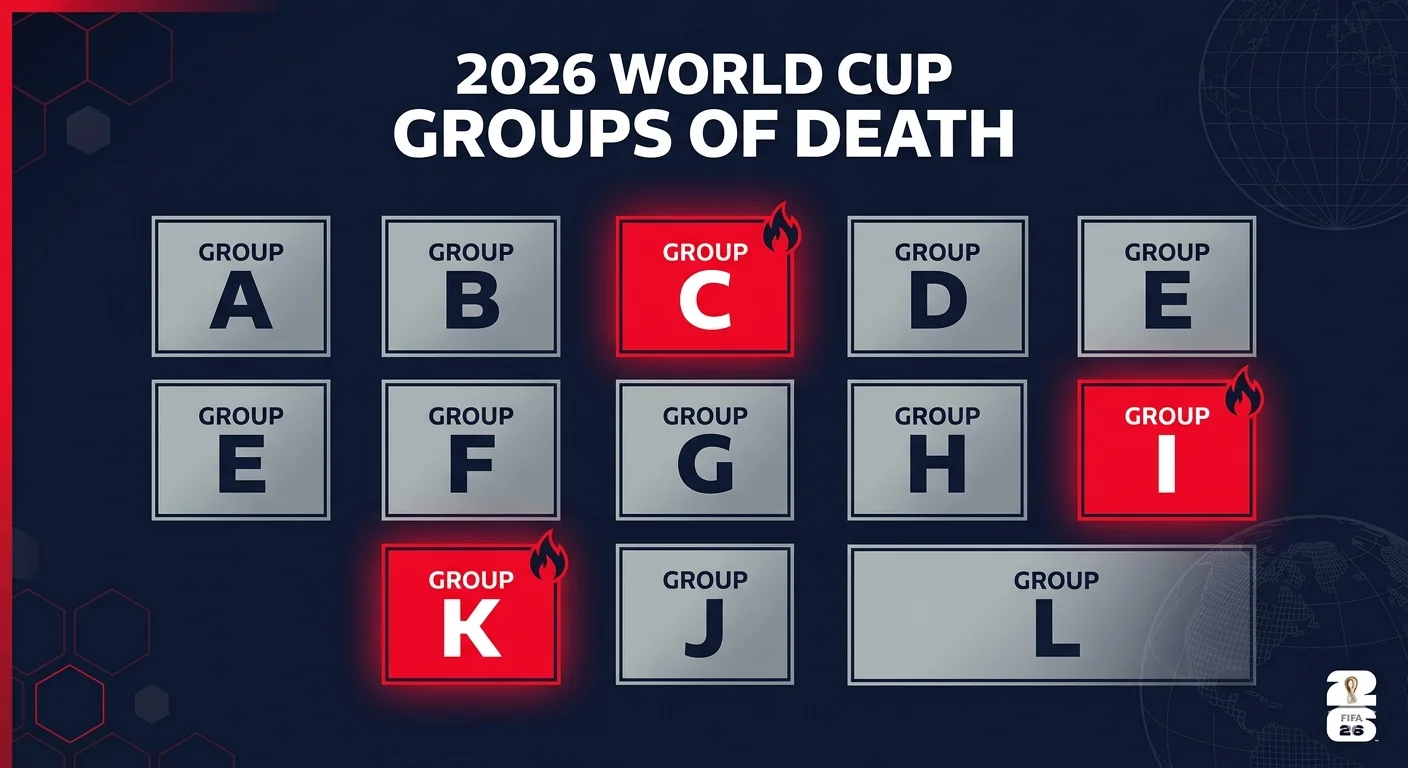
Group I — containing France, Norway, Senegal and Iraq — is the strongest case for the toughest group at the 2026 World Cup. Group C (Brazil, Morocco, Scotland, Haiti) and Group K (Portugal, Colombia, Uzbekistan, DR Congo) are the other serious contenders. Any of the three would be a group of death at any previous World Cup; in 2026, they exist simultaneously.
Want to see if your favourite team can navigate their group and go all the way? Build your 2026 World Cup bracket at CupRoute.
What is the "group of death" at the 2026 World Cup?
The term "group of death" refers to any World Cup group where the quality of teams is so high that one or more genuine contenders is likely to be eliminated before the knockout rounds even begin. In a normal year, one or two groups fit the description. In 2026, with twelve groups and the most competitive 48-team field in World Cup history, there are several.
The expanded format has not diluted quality at the top — it has concentrated it. Europe's 16 teams include multiple sides capable of winning the tournament. South America's six teams contain four of the world's top ten ranked nations. The result is that several groups contain three teams who would have comfortably qualified from any group at previous tournaments — but only two can go through automatically.
Group I: France, Norway, Senegal, Iraq
The verdict: the strongest claim to Group of Death
This is the group that most analysts, pundits and fans have circled as the most brutal draw in the entire tournament.
France are one of the two or three best teams in the world. Kylian Mbappé, Rayan Cherki, Bradley Barcola, Désiré Doué — the attacking resources available to Didier Deschamps are extraordinary. France do not lose group stage matches at major tournaments. They are a near-certain qualifier from any group they are drawn into.
That means Norway — Erling Haaland's Norway, the side that qualified with a perfect record and the most prolific individual scoring campaign of any qualified nation — are fighting Senegal for second place. Senegal are AFCON runners-up, coached by Aliou Cissé, and contain one of the deepest squads the country has ever sent to a World Cup. They beat Egypt in the 2022 Africa Cup of Nations final. They have Premier League-level talent throughout.
Norway and Senegal would both qualify comfortably from nine of the other eleven groups. In Group I, one of them is almost certainly going home after three matches.
Iraq are the fourth team — capable of an upset on a good day, but not expected to contend for qualification.
Group C: Brazil, Morocco, Scotland, Haiti
The verdict: the most high-profile group of death
This is the group that will generate the most television coverage, the most column inches, and the most misery for Scottish fans.
Brazil remain one of the most feared teams in the world. Vinícius Júnior — the reigning Ballon d'Or holder — leads a side that has the individual quality to beat anyone on their day. The question with Brazil is always whether the collective functions smoothly enough around their outstanding individuals. Under their current setup, the answer is more often yes than in previous cycles.
Morocco are AFCON champions — or at the very least, the strongest African side at the tournament. Their 2022 World Cup run to the semi-finals, where they became the first African nation to reach that stage, was not an accident. They are defensively structured, technically accomplished, and emotionally resilient in knockout football. In most groups, Morocco would be considered a genuine contender to finish second. In Group C, they need to get past Brazil first.
Scotland are in this group as well, which is simultaneously wonderful and terrifying for Steve Clarke's side. Getting past Brazil and Morocco to qualify automatically would be one of the greatest achievements in Scottish football history. Finishing third and hoping to be one of the eight best third-place teams is a more realistic scenario — but Scotland's group-stage goal difference will need to be carefully managed if that is the plan.
Group K: Portugal, Colombia, Uzbekistan, DR Congo
The verdict: the quietest group of death
This is the group that gets less attention than Groups I and C, but is arguably just as demanding for the teams involved.
Portugal enter the tournament in a transitional period. Roberto Martínez has built a squad around Bruno Fernandes, Bernardo Silva, Rafael Leão and the emerging João Neves — a genuinely talented side capable of reaching the final stages of the tournament. They are clear favourites to top the group.
Behind them, Colombia are ranked ninth in the world, reached the Copa América 2024 final, and have Luís Díaz — one of the most dangerous wide forwards on the planet — leading their attack. Colombia in most groups would be comfortable qualifiers. In Group K, they are competing with Portugal for the top spot, and the prize for finishing second could be a Round of 32 clash against Group L's runner-up — which could mean England.
DR Congo are not the pushover the draw might make them appear. They qualified from a competitive CAF group and have Champions League-level talent in their squad. Uzbekistan are making their World Cup debut and will be well-organised and hard to break down.
Portugal will qualify. The battle between Colombia and DR Congo for second place is one of the most underrated storylines of the group stage.
Which groups are more straightforward?
Not every group deserves the "group of death" label. Several offer a clearer path to qualification.
Group B (Canada, Switzerland, Bosnia and Herzegovina, Qatar) is the most navigable of the groups containing a serious contender. Switzerland and Canada should qualify comfortably. Group D (United States, Paraguay, Australia, Türkiye) is another group where two teams — the United States and Türkiye — are significantly above the others.
Group J (Argentina, Algeria, Austria, Jordan) is gentler than Argentina's status as defending champions might suggest. Algeria and Austria are organised and difficult to beat, but Argentina are a different class. This is a group where Argentina are expected to win comfortably, with Austria most likely to claim second.
The 2026 format, with its eight third-place qualifiers, also provides a safety valve. A team that narrowly misses automatic qualification from a group of death can still advance — as long as their points tally and goal difference is strong enough relative to the other third-placed teams across all twelve groups.
Which group is the easiest at the 2026 World Cup?
Group E — Germany, Curaçao, Côte d'Ivoire, Ecuador — is the group most analysts would choose to be in. Germany are expected to qualify as group winners. The remaining three teams are competitive but not of the quality that would threaten a major European side in top form. Côte d'Ivoire are the most capable of the remaining three, but Germany are too strong a side to be seriously threatened here.
Group G (Belgium, Egypt, Iran, New Zealand) is similarly navigable. Belgium's golden generation may be in its twilight, but Romelu Lukaku has 18 goals in his last qualifying campaign and this side remains capable of reaching the quarter-finals.
How do you think the groups play out? Build your full 2026 World Cup bracket at CupRoute — pick every result from the group stage to the final and see if your predictions hold up.
Share this article